

Custom API Integration Services That Connect Your Entire Business Ecosystem
Fragmented software stacks are one of the most expensive invisible problems a growing business carries. When your CRM cannot talk to your warehouse system, when your payment processor data lives separately from your analytics, and when your team moves data by copy-pasting between tools, you are losing hours every week and making decisions on incomplete information. At Determinds Solutions, we design and build custom API integration services that turn your collection of disconnected tools into a single, coordinated technology ecosystem. According to a MuleSoft Connectivity Benchmark Report, organisations manage an average of 900 applications, yet only 29% are integrated — leaving the majority of operational data siloed and inaccessible at the moment decisions are made. Our integration work closes that gap directly for your business. Whether you need a single webhook-driven connection between two SaaS tools or a full enterprise middleware layer coordinating dozens of systems, we architect, build, test, and monitor every integration to production grade.Our Integration Architecture Approach
Integration done wrong is worse than no integration at all. Brittle point-to-point connections accumulate technical debt, break unpredictably, and become impossible to debug at scale. We follow a structured integration architecture methodology grounded in OpenAPI Specification standards and industry-tested patterns — event-driven architecture, message queuing, and API gateway design — to ensure that every integration we deliver is observable, maintainable, and built to scale alongside your business. Every engagement begins with a discovery phase where we map your existing systems, data flows, authentication methods, and failure modes before writing a single line of code. The result is an integration blueprint your team can understand, extend, and hand to any future engineer without a knowledge-transfer crisis. If you are still evaluating whether integration or a custom build is the right path, our consulting and strategy team can help you make that call before you commit budget.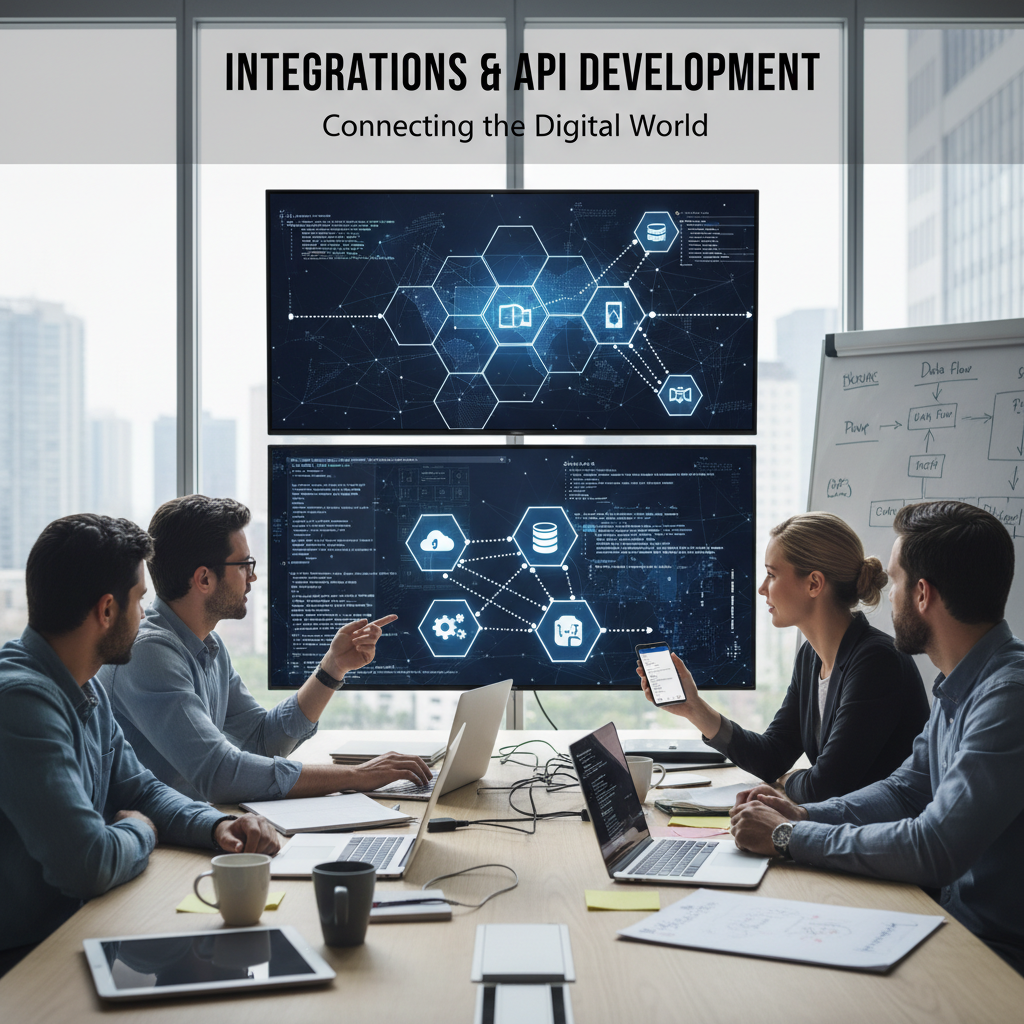
Comprehensive API Integration Solutions
Payment Gateway Integration
We build secure, PCI DSS-compliant payment integrations that support multiple processors — Stripe, PayPal, Adyen, Checkout.com, and regional gateways across GCC and MENA markets — alongside multi-currency handling, subscription billing, refund automation, and webhook-based reconciliation. Payment data flows directly into your reporting and finance systems without manual exports, eliminating reconciliation delays and human error.Shipping, Logistics & Warehouse Management
Connect your order management system, inventory database, and fulfilment partners through real-time API integrations with carriers including DHL, FedEx, UPS, Aramex, and third-party logistics providers. We automate label generation, tracking event ingestion, stock-level synchronisation, and return workflows so your warehouse team operates on live data rather than end-of-day batch files. These integrations pair directly with the custom backend systems we build and maintain for e-commerce and logistics clients.CRM & Salesforce Integration
Salesforce is only as powerful as the data feeding it. We build bi-directional integrations between Salesforce and your ERP, marketing automation, customer support, billing, and communication platforms using the Salesforce REST and Bulk APIs. The result is a CRM that reflects real-time deal status, customer activity, and revenue data — giving your sales team context they can act on immediately rather than data they have to hunt for.Email Marketing & Marketing Automation
We integrate Mailchimp, Klaviyo, HubSpot, ActiveCampaign, and enterprise marketing platforms with your CRM, e-commerce store, and customer data systems. Trigger sequences fire on real events from your backend — a purchase, a subscription upgrade, a support ticket — rather than on delayed batch imports. The integration layer handles consent management, list hygiene, event deduplication, and unsubscribe synchronisation so your campaigns stay compliant and your data stays clean.Google, Meta & Digital Marketing Platform Integrations
Accurately attributing revenue to campaigns requires your conversion data to flow from your backend directly into Google Ads, Google Analytics 4, and Meta Business Manager via server-side events — not browser pixels alone. We build server-to-server integrations using the Google Measurement Protocol and Meta Conversions API that survive ad-blocker and cookie-consent limitations, giving your marketing team accurate ROAS data to optimise against.AI, LLM & ChatGPT Integrations
We embed large language model capabilities directly into your existing workflows — customer support queues, internal knowledge bases, document processing pipelines, and product surfaces — through integration with OpenAI, Anthropic Claude, and open-source model APIs. These are not demo wrappers; they are production-grade integrations with context management, rate-limit handling, fallback routing, and cost controls built in. See our dedicated AI technology services page for the full scope of what we build.Analytics, BI & Data Pipeline Integrations
Raw data scattered across SaaS tools is not business intelligence. We build ETL and reverse-ETL pipelines that consolidate events, transactions, and user behaviour from every platform into a central data warehouse — Snowflake, BigQuery, Redshift, or your preferred destination — where your BI tools and analysts can query it without waiting for an engineer. Custom dashboards in Metabase, Looker, or Power BI surface the metrics that matter to each team in real time.Custom API Development
Where off-the-shelf connectors do not exist or cannot meet your performance and security requirements, we design and build custom APIs from scratch. Our APIs are documented with OpenAPI / Swagger specifications, secured with OAuth 2.0 and API-key authentication, rate-limited, versioned, and tested end-to-end before they handle a single production request. Whether you are building internal microservice communication, a developer-facing public API, or a mobile app backend, our custom backend development team delivers APIs that are designed to be extended, not replaced.Our Integration Delivery Process
1. Discovery & System Mapping
We audit every system involved — authentication methods, rate limits, data schemas, webhook capabilities, and existing failure modes — before designing anything.2. Integration Architecture Design
We produce a written integration blueprint covering data flow diagrams, error handling strategy, retry logic, and monitoring hooks. You review and approve it before we build.3. Development & Unit Testing
Integration code is written with full test coverage. We test against both sandbox and production API environments, including edge cases like rate-limit exhaustion, partial failures, and malformed payloads.4. End-to-End Testing & UAT
We run full end-to-end scenarios against production-grade data volumes before handover. You participate in UAT with a structured test plan, not ad-hoc clicking.5. Deployment & Monitoring Setup
Integrations are deployed with alerting configured for failure rates, latency spikes, and data sync lag. Our maintenance and support team can monitor your integrations on an ongoing basis so issues surface before your operations team notices them.6. Documentation & Knowledge Transfer
Every integration we deliver includes technical documentation, runbooks for common failure scenarios, and a handover session with your internal team.Why Businesses Choose Determinds for API Integration
Protocol-Agnostic Expertise: We work across REST, SOAP, GraphQL, gRPC, and message-broker patterns (RabbitMQ, Kafka) — not just the easy-to-connect SaaS APIs. Complex legacy systems and enterprise middleware are within scope. Security-First Design: Every integration we build enforces least-privilege credential scoping, encrypted secrets management, TLS in transit, and input validation. We do not hard-code credentials or skip certificate verification to ship faster. Operational Observability: We instrument every integration with logging, alerting, and dashboards from day one. When something breaks at 2 am, you know about it before your customers do. Web, Mobile & Backend Coverage: Our integration work spans the full stack we build — from web platforms and mobile applications to backend services and data pipelines — so there is one accountable partner, not a chain of vendors pointing at each other. Long-Term Reliability: Integrations need ongoing maintenance as third-party APIs deprecate endpoints, change authentication requirements, and update data schemas. Our maintenance retainers cover your integrations with the same SLA rigour as your core application.Frequently Asked Questions
An API integration connects two existing systems using their published APIs — for example, syncing Salesforce with your billing platform. A custom API is a new interface we build from scratch so that your own system can expose functionality to other applications, your mobile app, or external developers. Many projects involve both: we build your custom API and then integrate it with third-party services.
Scope varies significantly. A single, well-documented SaaS-to-SaaS integration with clear requirements typically takes two to four weeks including testing. A multi-system enterprise integration involving legacy APIs, custom data transformations, and phased rollout can run two to four months. We scope every engagement with a written specification and timeline before the build starts so there are no surprises.
Yes, with some caveats. If a system exposes database access, file exports, or supports webhook configurations, we can build a data pipeline around it. For older systems with no API, we evaluate options including database-level integration, RPA-style automation, or proposing a controlled migration. We will tell you honestly which approach is right rather than overpromising what the system can support.
We use environment-scoped secrets management — AWS Secrets Manager, HashiCorp Vault, or your cloud provider’s equivalent — so credentials are never stored in code or version control. Authentication flows use OAuth 2.0 where the API supports it, with short-lived token rotation and least-privilege scoping. We document every credential and its rotation schedule as part of the handover package.
Our monitoring alerts us to integration failures before your team notices them. For planned deprecations, we track API changelogs and proactively migrate ahead of deadlines. If you are on a maintenance retainer, third-party API changes are handled within your SLA at no additional project cost for minor version updates. Major breaking changes are scoped as small projects with transparent pricing.
Yes. We have experience integrating regional payment gateways including Paymob, Fawry, MPGS, Cybersource, Stripe. We also work with global platforms operating in GCC markets and understand the compliance requirements.
Yes. We regularly inherit integration code from previous vendors or internal development teams. We start with a technical audit to understand what was built, document what is missing, and stabilise any high-risk components before assuming ongoing responsibility. If anything poses immediate operational risk, we surface it in the audit report before signing an SLA.
Disconnected tools cost your business time, accuracy, and competitive agility every day they remain siloed. Let us design an integration architecture that makes your platforms work together the way your business requires. Contact Determinds today to discuss your integration requirements — or book a strategy session if you are still mapping out which systems need to be connected and in what order. Learn more about the team who will design and build your integrations.