

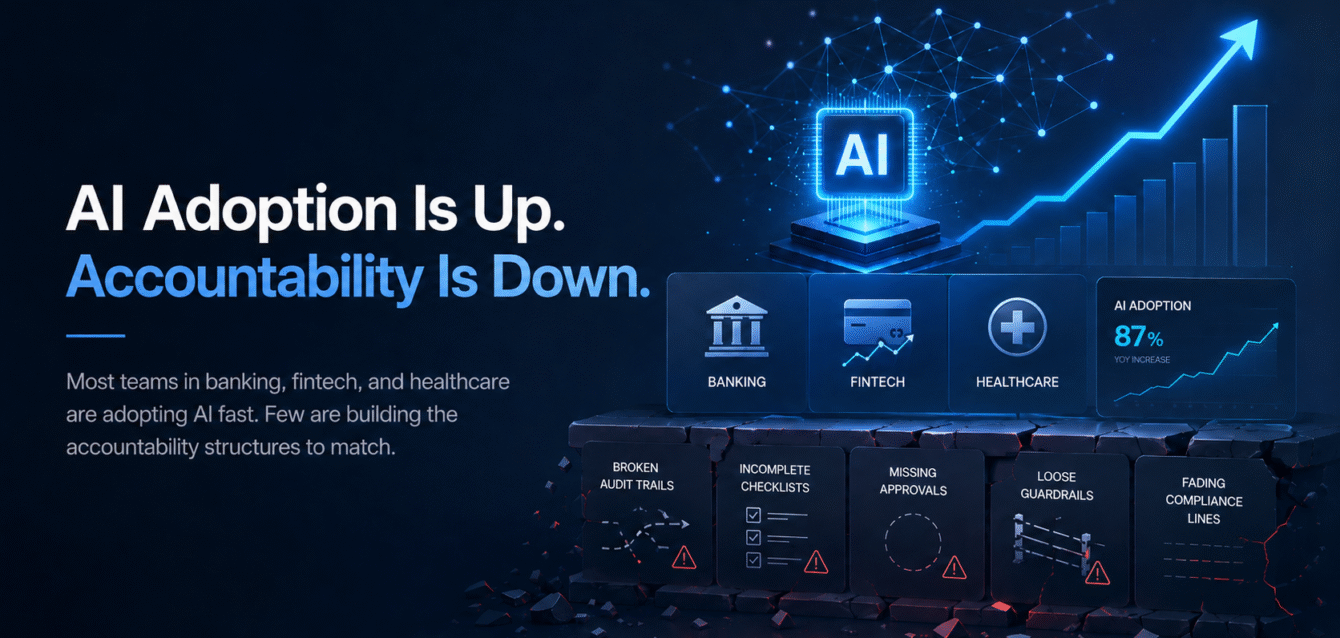
- AI adoption is accelerating across MENA and the Gulf, but critical thinking and accountability are not keeping pace.
- In regulated industries (banking, fintech, healthcare, government), the cost of shallow AI adoption is not a bad user experience. It is compliance exposure, failed audits, and systems that cannot be maintained.
- The teams that benefit most from AI treat it as an input to human decision-making, not a replacement for it.
- Responsible AI adoption means choosing the right intervention for the right problem: document intelligence, RAG-based search, copilots, classification, and matching each solve a specific class of problem.
- Accountability for the output must stay with the team that built and operates the system.
- At Determinds, we build AI systems for regulated industries with one standard: we own the output, fully.
Table of Contents
- The Pattern: What Is Actually Happening
- What This Actually Costs
- What Responsible AI Adoption Looks Like
- How Determinds Approaches It
- The Standard We Hold To
- Frequently Asked Questions
- Conclusion
Something is happening across engineering teams in Egypt and the Gulf right now, and it deserves a direct conversation.
AI adoption is accelerating. The tools are better, faster, and more accessible than they have ever been. Most organizations have moved past the question of whether to adopt AI. The question now is how.
And from what I am seeing across clients and partners in banking, fintech, healthcare, and real estate, a lot of teams are getting that part wrong.
1. The Pattern: What Is Actually Happening
Over the past two years, we have worked with organizations across banking, fintech, procurement, real estate, and healthcare. In nearly every industry, we observe the same shift: AI tooling is being adopted quickly, but the thinking and accountability that should accompany it is not keeping pace.
The symptoms are specific. Developers shipping code they cannot explain. Deliverables that pass review on the surface and fall apart during maintenance or scale. Teams using AI to complete tasks that a basic, deterministic tool would handle faster and more reliably. Decisions made based on model output without anyone in the loop who fully understands the logic.
A 2024 McKinsey report on generative AI adoption found that while AI adoption has more than doubled in two years, fewer than 25% of organizations report having formal governance or accountability structures in place for AI outputs. The gap between deployment speed and accountability infrastructure is widest in emerging markets.
None of this is a technology problem. It is a judgment problem.
2. What This Actually Costs
In consumer applications, the cost of low-quality AI output is often recoverable. A bad recommendation gets dismissed. A poorly written email gets ignored.
In regulated industries, the margin is different.
A banking KYC/AML workflow that produces unreliable output does not just create a support ticket. It creates compliance exposure under frameworks like the CBUAE’s AI governance guidelines or Egypt’s Financial Regulatory Authority standards. A healthcare application where the logic cannot be traced or explained does not just frustrate a developer. It fails an audit. A procurement system where outputs cannot be defended creates organizational risk at the moment it matters most.
The quality gap that comes from shallow AI adoption shows up slowly, then all at once. Systems that looked complete during delivery reveal their fragility under real operational conditions. The cost of fixing them at that stage, in terms of time, money, and trust, is significantly higher than building them correctly from the start.
According to Gartner’s 2025 AI Hype Cycle, a leading cause of enterprise AI project failures is lack of human oversight and unclear accountability for model outputs, not model quality.
3. What Responsible AI Adoption Looks Like
The teams and organizations genuinely benefiting from AI share a few consistent traits.
They treat AI as a tool that augments decision-making, not one that replaces it. The output of a model is input to a human decision, not the final word. Accountability stays with the team. This is especially important in regulated contexts where a regulator will ask a human, not a model, to explain a decision.
They are specific about where AI adds value. Not every workflow needs a large language model. Document intelligence, RAG-based search, classification, and matching engines each solve a particular class of problem well. Applying the right level of AI intervention to the right problem is a design decision, not a default.
They invest in understanding what they have built. Engineers who can explain how a system behaves under edge cases. QA processes that test AI components the same way any other system component is tested. Documentation and architecture that a new team member can pick up six months later.
They build human-in-the-loop mechanisms for high-stakes decisions. Especially for regulated environments, automation and accountability are not opposites. The EU AI Act, which is now influencing AI governance standards across MENA through trade agreements and multinational clients, specifically mandates human oversight for high-risk AI applications. The best implementations design for this from day one.
4. How Determinds Approaches It
At Determinds, we have built AI-powered systems for banking, fintech, healthcare, procurement, and real estate across MENA and the Gulf. The projects that hold up over time share a common foundation: we started from the business problem, not the technology.
Our approach begins with a discovery phase focused on identifying a specific high-value workflow, understanding the data and process environment, and deciding on the appropriate level of AI intervention. Not every problem requires a multi-agent system. Some require a well-scoped RAG implementation. Some require a classification model. Some require a carefully designed copilot that keeps a human in the loop at the right decision points.
From there, we move to a rapid proof of concept, iterate with real business users, and harden for production with close attention to security boundaries, data handling, and integration requirements. For banking and regulated environments specifically, deployment architecture is not an afterthought. It shapes every design decision from the start.
We work with organizations that cannot afford ambiguity in their systems: a Gulf bank processing thousands of KYC documents per day, a healthcare platform operating under HIPAA-equivalent standards, a government procurement system that must be fully auditable. In each case, the standard is the same: the system must be explainable, maintainable, and defensible.
The result is AI systems that work, can be maintained, can be explained to a regulator, and improve over time rather than degrade.
5. The Standard We Hold To
I am genuinely enthusiastic about what AI can do for organizations across this region. The opportunity is real, and the best cases we have seen have produced measurable improvements: significant reductions in manual processing time, faster access to critical information, and meaningful efficiency gains on tasks that were absorbing valuable team hours.
But the standard has to be: we own the output, fully.
AI should support the thinking on your team, not replace it. If the people building or operating a system cannot explain how it works, that is not a sign of advanced technology. It is a sign of a gap in accountability that will surface at the worst possible moment.
Organizations that get this right will build systems that last. The ones that treat AI adoption as a speed shortcut will spend the next few years rebuilding.
Use AI. Own the output.
Frequently Asked Questions
Is AI adoption actually causing problems in regulated industries across MENA?
Yes, and it is a growing concern. The issue is not AI itself but the speed of adoption relative to governance. Organizations in banking, fintech, and healthcare are deploying AI tools faster than they are building oversight structures. The risk shows up in compliance reviews, system failures under scale, and AI outputs that cannot be traced or explained when a regulator asks.
What is human-in-the-loop AI, and why does it matter for regulated industries?
Human-in-the-loop (HITL) means designing AI systems so that a human reviews, approves, or can override AI outputs at critical decision points. In regulated environments, this is not optional. The EU AI Act classifies high-risk AI applications (credit scoring, medical diagnostics, identity verification) as requiring mandatory human oversight. Even in MENA markets without equivalent legislation, regulators routinely expect explainability and accountability in financial and healthcare systems.
How do I know which AI approach is right for my workflow?
Start with the problem, not the technology. The right question is not “can we use AI here?” but “what does this workflow need that AI can provide better than existing tools?” Document extraction, semantic search, classification, and workflow automation each have specific use cases where they consistently perform well. A discovery process with a technical partner can map your workflows to the right intervention level. Determinds offers a free consultation to help organizations start this assessment.
What does a responsible AI implementation project look like end-to-end?
A well-structured AI implementation typically follows: (1) use-case discovery and business goal validation, (2) data and workflow analysis, (3) solution architecture and tool selection, (4) rapid proof of concept, (5) pilot with real users, (6) production hardening with security and compliance review, and (7) ongoing monitoring. Each phase should include clear accountability for outputs and documented decision logic.
Why do some AI projects look successful at delivery but fail in production?
Because delivery success and operational success are measured differently. A system can pass all acceptance criteria and still produce outputs that degrade under edge cases, cannot be explained to a regulator, or require an engineer who no longer works at the company to maintain. Operational success requires that the system is explainable, testable, and maintainable by the team that inherits it, not just the team that built it.
How does Determinds handle compliance requirements for AI in banking or healthcare?
We treat deployment architecture, security boundaries, and data handling as first-class design concerns, not post-delivery checklists. For banking, this means CBUAE and Central Bank of Egypt-aligned data residency and audit trail requirements. For healthcare, HIPAA-equivalent data handling standards. For government clients, on-premise or private cloud deployment where required.
Conclusion
The question facing organizations across Egypt, the UAE, and the Gulf is no longer whether to adopt AI. That decision has been made. The question is whether the adoption is being done in a way that will hold up.
The pattern that creates risk is consistent: AI tooling deployed quickly, accountability structures built slowly or not at all. In regulated industries, that gap is not just a quality issue. It is a compliance and business continuity issue.
The path forward is straightforward, though not simple. Start from the business problem. Choose the right level of AI intervention. Keep accountability with the team. Build systems that can be explained, maintained, and improved. In regulated environments, design for human oversight from day one.
Organizations that build this way will have AI systems that compound in value over time. The ones that treat adoption as a checkbox will find themselves rebuilding sooner than they expect.
If you are assessing how to introduce AI into your operations responsibly, or if you have a system already deployed that you want to audit or improve, the Determinds team is available to help.
Ready to Build AI the Right Way?
Determinds works with banks, fintechs, healthcare organizations, and enterprises across MENA and the Gulf to design and build AI systems that are production-grade, compliant, and accountable. We offer a free initial consultation to assess your use case, identify the right AI intervention, and outline a delivery approach.
Book Your Free Consultation Call →Related Resources from Determinds
- AI and GenAI Solutions — Document intelligence, RAG-based search, AI copilots, multi-agent systems, and workflow automation.
- Custom Software Development — Full-stack web and mobile applications built from scratch with long-term maintainability as a core requirement.
- Product Consulting and Strategy — From use-case discovery to production roadmap.